This small lidded pot was handcrafted in Rajasthan, India, a region famous for its painted bone and woodwork. It’s made from panels of camel bone fitted over a wooden core, then hand painted in gold, red and green, and it’s complete with its small fitted lid.
Date: 20th century
Geography: Rajasthan, India
Dimensions: Approx. 4cm H x 8cm W x 8cm D
Weight: 144g
Material: Camel bone over a wooden core, hand painted
Condition: Good. See photos.
The design
The pot has a low, rounded shape, with a raised central section and a neat fitted lid at the top. A swirling floral design radiates out from the centre, made of flowers and curling leaves in red, green and gold. A band of trellis pattern runs around the sides, outlined in black and picked out with gold dots.
History
Small lidded pots like this are traditionally known as opium pots. In Rajasthan, opium, known locally as amal, was historically shared at ceremonies and gatherings as a gesture of hospitality, and small decorative containers were made to hold it. Today they make lovely little boxes for rings, earrings, keepsakes or trinkets.
Painted bone work is a long-standing craft in Rajasthan. Camel bone, a by-product of a region where camels are part of everyday life, is cut, smoothed and fitted by hand before artists paint each pattern freehand with fine brushes.
This pot is camel bone, not ivory. Bone has a similar creamy colour, and small dark flecks and the natural grain are often visible on close inspection.
As with all our vintage pieces, this pot is one of a kind, and natural variations in the bone and the hand painting are part of its character. Dimensions and weight are approximate.

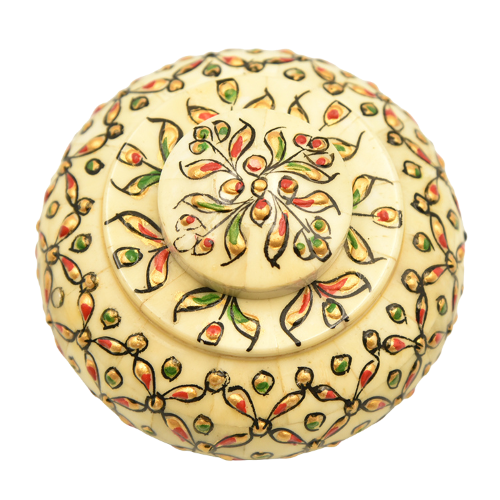 Image 1 of 6
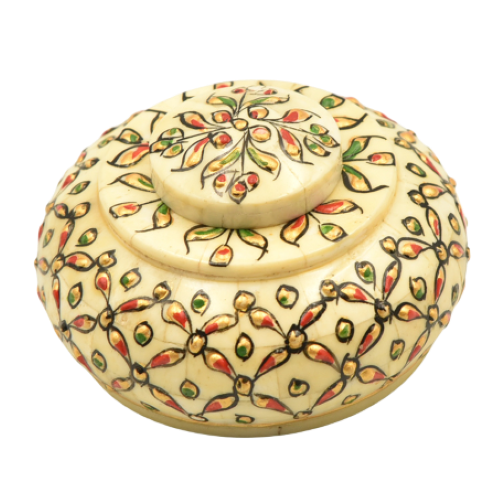 Image 2 of 6
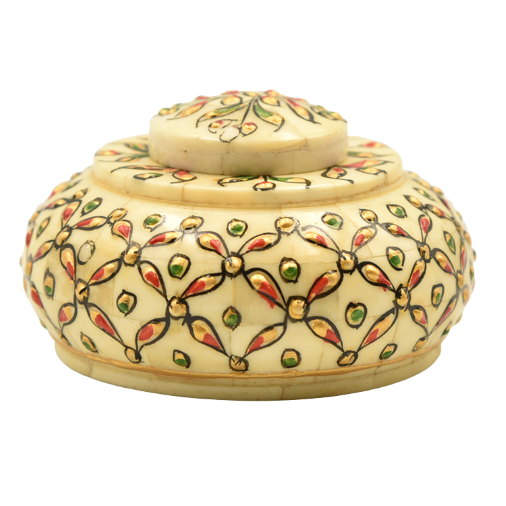 Image 3 of 6
 Image 4 of 6
 Image 5 of 6
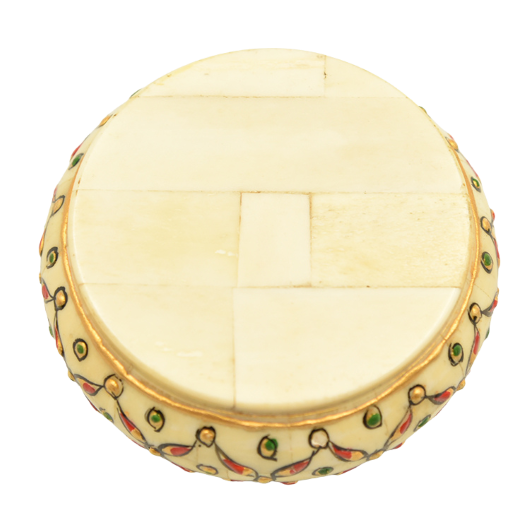 Image 6 of 6